
The Roadmap 2050: Towards Regenerative Yachting
The Roadmap 2050 is the yachting industry’s shared plan to reach net-zero emissions by 2050.
The Roadmap 2050 sets clear, measurable targets every five years, covering every stage of a yacht’s life from design and build, through operation and refit.
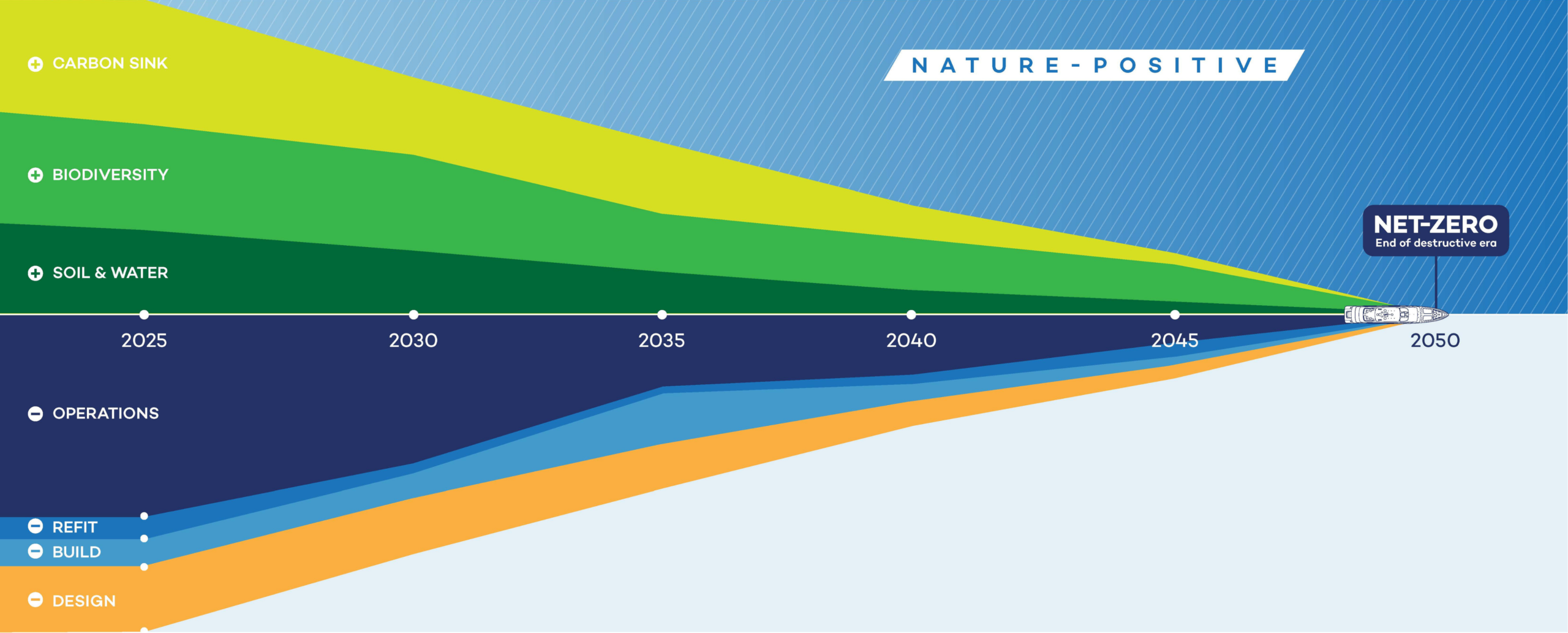
A united industry effort
Backed by industry leaders and developed through real data and collaboration, the Roadmap gives everyone in yachting — builders, designers, operators, and refit yards — a concrete direction to work towards. It’s voluntary, but built on the understanding that waiting for regulation is not an option.
Progress is tracked through a centralised monitoring system overseen by Water Revolution Foundation, with annual data submitted by participating companies across each life cycle stage. Voluntary doesn’t mean unaccountable. Companies that sign up commit to transparent reporting and progress against targets is shared publicly so the industry can see, collectively, where it stands.
Leah Werner, Executive Director of Water Revolution FoundationThe challenge of sustainability is too large for any company to solve alone. The Roadmap 2050 creates a shared direction for our industry, enabling us to measure progress, learn from one another, and work collectively toward a regenerative future for yachting.
How it works
The Roadmap is built around three principles that work in sequence: Reduce, Remove and Restore. Our programmes, guidelines, tools & resources are designed to service one or more of these areas, helping the industry to act and improve their environmental impact:
REDUCE
The first and most important step. Every life cycle stage has targets to cut energy use, minimise waste, and reduce water consumption. Lowering the impact at the source always comes before anything else.
REMOVE
For emissions that cannot be eliminated at source, the Roadmap targets active carbon removal, through nature-based solutions and high-integrity removal projects — once reduction measures have been maximised, through high-integrity, nature-based carbon removal projects such as the Venice Lagoon or the IMMA programme. This is distinct from simply avoiding emissions: removal addresses what has already entered, or will inevitably enter, the atmosphere. Compensation is the bridge, not the destination.
Explore our programmes, guidelines, tools & resources designed to support the reduce and remove pillars:
RESTORE
Going further than just compensation, the Roadmap encourages the industry to actively give back to the oceans it depends on. The Foundation’s Ocean Assist programme provides a structured way to fund ocean restoration, with scientific protocols developed by the TETIS Institute and peer-reviewed by the University of Genoa, and for those who go beyond neutralising their impact, it opens the door to becoming truly nature-positive.
What’s next
The Foundation is setting up a centralised data monitoring system so the whole industry can track progress together. Trade associations are invited to embed the Roadmap targets into their agendas, and roundtables will be organised for each life cycle stage throughout the coming years.
If you’d like to be part of a roundtable or learn more about the Roadmap 2050, please reach out to us at info@waterrevolutionfoundation.org.
Dr. Vienna Eleuteri, Vice Chair of Water Revolution FoundationThe Roadmap signals to the world that our industry is not waiting for change, we are leading it.